Understanding Pest Control: An Informative Guide
Pest control encompasses the management and regulation of species defined as pests. In 2026, with evolving climates and increased global trade, understanding effective and responsible pest control strategies is more critical than ever for protecting public health, agriculture, and infrastructure. This guide offers a comprehensive overview of pest control methods, considerations, and long-term management practices.
Pest control is a broad field involving the regulation and management of species deemed detrimental to human interests. These interests can range from agriculture and property to public health and ecological balance. The term "pest" itself is anthropocentric, meaning it is defined by its negative impact on human activities, rather than any inherent quality of the organism itself. Understanding the principles and practices of pest control is crucial for mitigating potential harm and promoting sustainable coexistence with the natural environment.
Practical Guidance: Evaluating Pest Control Options
Selecting the appropriate pest control method requires careful evaluation of several factors. These include the specific pest involved, the extent of the infestation, the surrounding environment, and the potential impact on non-target organisms. A one-size-fits-all approach is rarely effective, and an integrated pest management (IPM) strategy is often the most sustainable and responsible solution.
1. Identification of the Pest
Accurate identification is the cornerstone of effective pest control. Misidentification can lead to the use of inappropriate methods, resulting in ineffective control and potential harm to the environment. Resources such as entomological keys, field guides, and expert consultations can aid in accurate identification. Knowing the pest's life cycle, habits, and vulnerabilities is essential for targeting control efforts effectively.
2. Assessment of the Infestation Level
Determining the severity of the infestation is crucial for selecting the appropriate control measures. Minor infestations may be manageable through non-chemical methods, while severe infestations may require more aggressive interventions. Monitoring techniques, such as traps, visual inspections, and damage assessments, can help quantify the extent of the problem. Keeping detailed records of pest activity can also aid in tracking the effectiveness of control efforts over time.
3. Consideration of Environmental Impact
Pest control methods can have unintended consequences on the surrounding environment. It is essential to carefully evaluate the potential impact of each method on non-target organisms, water quality, soil health, and air quality. Opting for methods with minimal environmental impact is a key principle of IPM. This may involve selecting pesticides with low toxicity, using targeted application techniques, and implementing preventative measures to reduce the need for chemical interventions.
4. Evaluation of Control Options
A wide range of pest control methods are available, each with its own advantages and disadvantages. These can be broadly categorized into non-chemical and chemical methods. Non-chemical methods include habitat modification, exclusion, trapping, and biological control. Chemical methods involve the use of pesticides, which can be further classified based on their mode of action and target pests.
a. Non-Chemical Methods
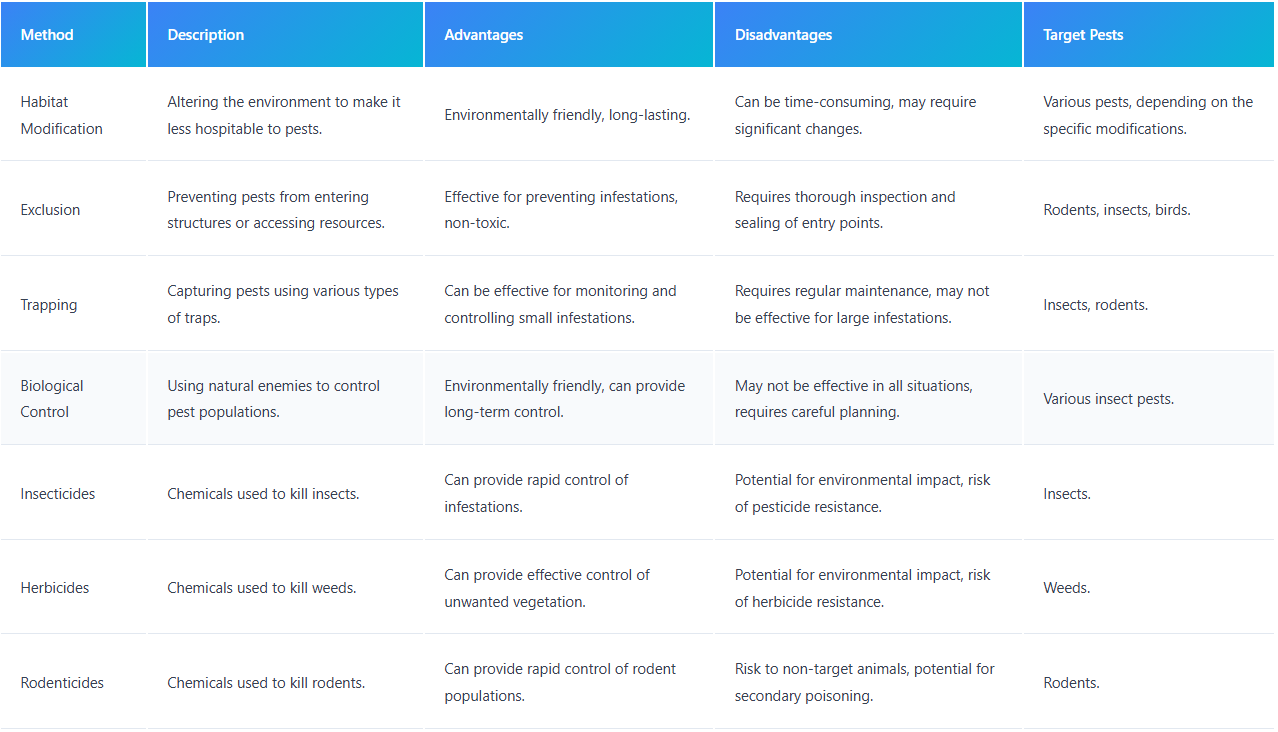
- Habitat Modification: Altering the environment to make it less hospitable to pests. Examples include removing food sources, eliminating standing water, and improving sanitation.
- Exclusion: Preventing pests from entering structures or accessing resources. This can involve sealing cracks and crevices, installing screens, and using netting.
- Trapping: Capturing pests using various types of traps. Traps can be baited with attractants or designed to physically capture pests.
- Biological Control: Using natural enemies, such as predators, parasites, and pathogens, to control pest populations.
b. Chemical Methods
- Insecticides: Chemicals used to kill insects. Insecticides are available in various formulations, including sprays, dusts, granules, and baits.
- Herbicides: Chemicals used to kill weeds. Herbicides can be selective, targeting specific weed species, or non-selective, killing all vegetation.
- Rodenticides: Chemicals used to kill rodents. Rodenticides are typically formulated as baits and can pose a risk to non-target animals.
- Fungicides: Chemicals used to control fungal diseases. Fungicides are commonly used in agriculture and horticulture.
5. Integrated Pest Management (IPM)
IPM is a comprehensive approach to pest control that emphasizes prevention, monitoring, and the use of multiple control methods. IPM aims to minimize the use of pesticides by employing non-chemical methods whenever possible and using pesticides only when necessary and in a targeted manner. The key principles of IPM include:
- Prevention: Implementing measures to prevent pest infestations from occurring in the first place.
- Monitoring: Regularly monitoring for pest activity and assessing the extent of infestations.
- Thresholds: Establishing thresholds for pest populations that trigger the need for control measures.
- Multiple Tactics: Using a combination of control methods, including non-chemical and chemical methods.
- Evaluation: Evaluating the effectiveness of control efforts and adjusting strategies as needed.
Long-Term Considerations: Responsibilities, Risks, and Limitations
Effective pest control is not a one-time event but rather an ongoing process that requires long-term planning and management. Ignoring long-term considerations can lead to recurring infestations, increased costs, and potential environmental damage. Key aspects of long-term pest control include:
1. Prevention and Monitoring
Implementing preventative measures is crucial for minimizing the risk of future infestations. This includes maintaining good sanitation practices, sealing entry points, and removing potential food and water sources. Regular monitoring for pest activity allows for early detection and intervention, preventing infestations from becoming severe.
2. Understanding Pesticide Resistance
Pesticide resistance is a growing concern in pest control. Repeated use of the same pesticide can lead to the development of resistance in pest populations, rendering the pesticide ineffective. To mitigate the risk of resistance, it is important to rotate pesticides with different modes of action and to use non-chemical methods whenever possible.
3. Addressing Secondary Pest Outbreaks
The use of broad-spectrum pesticides can sometimes lead to secondary pest outbreaks. These occur when the pesticide eliminates beneficial insects that naturally control other pest species, leading to an increase in the populations of these secondary pests. To avoid secondary pest outbreaks, it is important to use targeted pesticides and to protect beneficial insects.
4. Regulatory Compliance
Pest control activities are often regulated by government agencies to protect public health and the environment. It is important to be aware of and comply with all applicable regulations, including those related to pesticide use, storage, and disposal. Failure to comply with regulations can result in fines, penalties, and legal action.
5. Community Education
Educating the community about pest control practices can help to reduce the risk of infestations and promote responsible pest management. This can involve providing information on preventative measures, safe pesticide use, and the importance of IPM.
Table: Comparison of Common Pest Control Methods
Internal Linking
For further information on specific pest species, consult resources like [Wikipedia - Entomology](https://en.wikipedia.org/wiki/Entomology) for detailed information on insect biology and identification. You can also research Integrated Pest Management practices at the [EPA's IPM Resources](https://www.epa.gov/managing-pests-schools/introduction-integrated-pest-management). Learn more about pesticide regulation and safety from the [National Pesticide Information Center](http://npic.orst.edu/). To delve into the science of pesticides, explore resources from [The Pesticide Properties Database](http://sitem.herts.ac.uk/aeru/ppdb/).
FAQ Section
What is the most effective method of pest control?
The most effective method depends on the specific pest, the extent of the infestation, and the surrounding environment. An integrated pest management (IPM) approach, which combines multiple control methods, is often the most sustainable and responsible solution.
Are pesticides harmful to humans?
Some pesticides can be harmful to humans if not used properly. It is important to follow all label instructions and to take precautions to minimize exposure. Opting for pesticides with low toxicity and using targeted application techniques can also reduce the risk of harm.
How can I prevent pest infestations?
Preventative measures include maintaining good sanitation practices, sealing entry points, removing potential food and water sources, and regularly monitoring for pest activity.
What is integrated pest management (IPM)?
IPM is a comprehensive approach to pest control that emphasizes prevention, monitoring, and the use of multiple control methods. IPM aims to minimize the use of pesticides by employing non-chemical methods whenever possible and using pesticides only when necessary and in a targeted manner.
How do I choose a pest control professional?
When choosing a pest control professional, look for someone who is licensed, experienced, and knowledgeable about IPM practices. Ask for references and check online reviews. Be sure to get a written estimate and understand the scope of the services being provided.
Disclaimer
This content is provided for informational purposes only and does not constitute professional advice. Consult with a qualified pest control professional for specific recommendations regarding your situation.
Sources
- [Environmental Protection Agency (EPA): Integrated Pest Management (IPM)](https://www.epa.gov/ipm)
- [National Pesticide Information Center (NPIC)](http://npic.orst.edu/)
- [University of California IPM Program](http://ipm.ucanr.edu/)
This guide provided a comprehensive overview of pest control, highlighting the importance of accurate pest identification, careful selection of control methods, and long-term management strategies. It emphasized the principles of Integrated Pest Management (IPM) as a sustainable and responsible approach to pest control, minimizing environmental impact and promoting long-term effectiveness. Key takeaways include the need for preventative measures, regular monitoring, and understanding the potential risks and limitations of different control methods.