Forklift Operator Guide 2026: Career Opportunities, Salary, and Industry Insights
In today’s rapidly growing logistics and supply chain environment, forklift operators play a critical role in maintaining the smooth movement of goods. As we move into 2026, the demand for forklift operator jobs near me continues to increase due to the expansion of e-commerce, large-scale warehousing, and global distribution networks. This guide provides a complete overview of forklift operator careers, including job responsibilities, training requirements, salary expectations, and long-term growth opportunities. Whether you are starting out or looking to advance, understanding this role can help you build a stable and rewarding career.
Understanding the Role of a Forklift Operator in 2026
Forklift operators are responsible for moving, stacking, and organizing materials in warehouses, factories, and distribution centers. Their work ensures that products flow efficiently from storage to shipping.
In 2026, the role has evolved beyond basic equipment handling. Operators often work with digital inventory systems, barcode scanners, and warehouse management platforms. This means accuracy, attention to detail, and basic technical skills are just as important as operating machinery.
From logistics hubs to construction sites, the demand for skilled operators remains strong, making forklift operator jobs hiring now a practical option for many job seekers.
Practical Guidance: How to Start a Forklift Career
1. Types of Forklift Jobs and Work Environments
Forklift operators can work in a wide range of industries, each requiring different skills and equipment.
Warehouse and Distribution Centers
The most common environment. Operators manage inventory, load trucks, and support order fulfillment using equipment like reach trucks and pallet jacks.
Manufacturing Facilities
Workers transport raw materials and finished goods within production lines, often requiring precision and coordination.
Construction Sites
Rough terrain forklifts are used to move heavy materials such as steel and concrete. This role requires strong safety awareness.
Ports and Shipping Terminals
Handling large cargo requires experience with heavy-duty forklifts and working in busy outdoor environments.
Cold Storage Facilities
Operators work in refrigerated conditions, requiring specialized equipment and adaptability to extreme temperatures.
2. Skills, Training, and Certification Requirements
Becoming a forklift operator requires both practical skills and formal training.
Key Skills
- Hand-eye coordination and spatial awareness
- Attention to detail and accuracy
- Strong focus on safety
- Basic communication skills
- Ability to follow instructions
Training and Certification
Most employers require forklift certification, which includes:
- Classroom safety training
- Hands-on equipment operation
- Written and practical evaluations
In the U.S., safety standards are guided by the Occupational Safety and Health Administration, which requires regular recertification to ensure operators stay updated.
3. Finding Forklift Operator Jobs Near You
The job market for forklift operator jobs near me hiring now is strong, and there are multiple ways to find opportunities:
- Online job platforms and recruitment sites
- Warehouse and logistics company websites
- Staffing agencies specializing in industrial roles
- Local employment centers
👉 Common searches include:
- “warehouse forklift jobs near me”
- “forklift operator hiring immediately”
- “apply forklift jobs near me”
Long-Term Career Development
1. Career Growth Opportunities
Forklift operator roles can lead to higher-level positions within logistics and operations. With experience, workers can move into:
- Team leader or lead operator
- Warehouse supervisor
- Logistics coordinator
- Operations manager
Some may also specialize in safety training or equipment management.
2. Continuous Training and Adapting to Technology
The logistics industry is constantly evolving. Staying updated is essential for long-term success.
- Regular certification renewal
- Training on new equipment
- Learning warehouse management systems (WMS)
- Understanding automation and robotics
Technology is transforming warehouses, and operators who adapt will have better career prospects.
3. Safety Responsibilities and Health Considerations
Safety is a key part of every forklift operator’s job. Workers must follow strict procedures to prevent accidents.
Key practices include:
- Daily equipment inspections
- Proper load handling
- Awareness of surroundings
- Following workplace safety rules
Physically, the job may involve long hours, repetitive movement, and different environmental conditions. Maintaining good health is important for long-term performance.
4. Salary and Job Outlook (2026)
Many job seekers are attracted by the steady income offered by forklift operator jobs near me. Pay levels vary depending on experience and work environment.
📊 Average Hourly Wage for Forklift Operators (2026 Estimate)
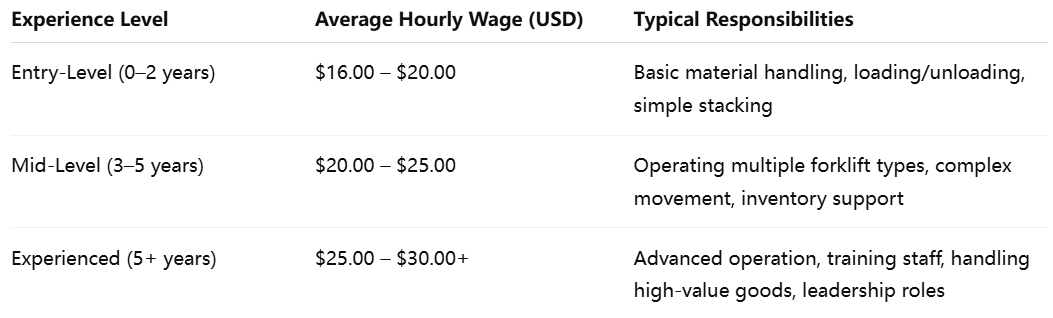
Salaries may increase based on location, overtime, and specialized skills. Demand is expected to remain stable due to ongoing growth in logistics and e-commerce.
Future Trends in Forklift and Logistics Careers
The future of forklift operations will be shaped by automation and technology. While machines are becoming more advanced, human operators remain essential for complex tasks.
Key trends include:
- Integration of automated systems
- Growth of smart warehouses
- Increased demand for skilled operators
- Expansion of urban distribution centers
These developments will continue to create job opportunities and improve efficiency in the industry.
Final Thoughts
Forklift operators are essential to modern supply chains, ensuring goods move safely and efficiently. With strong demand, competitive pay, and clear career paths, forklift operator jobs near me hiring now provide a reliable option for those seeking stable employment.
By gaining proper training, maintaining certification, and adapting to new technologies, individuals can build a long-term career in this growing field.
Frequently Asked Questions (FAQ)
Q1: What do I need to become a forklift operator?
A: You typically need to be at least 18 years old and complete a certified forklift training program that includes both theory and practical operation.
Q2: How long does forklift certification last?
A: Certification usually needs to be renewed every few years, depending on local regulations and employer requirements.
Q3: Can I get a forklift job with no experience?
A: Yes, many companies offer entry-level positions and on-the-job training for beginners.
Q4: Are forklift jobs in demand?
A: Yes, demand remains strong due to the growth of logistics, warehousing, and e-commerce industries.
Q5: Is automation replacing forklift operators?
A: Automation is changing the role, but skilled operators are still needed for complex tasks and oversight.