Beyond the Terminal: The Multi-Million Dollar Industry of Airport Cleaning and Aviation Facility Management
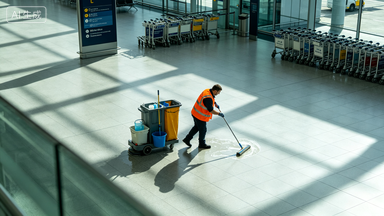
An airport is essentially a mini-city that never sleeps. With tens of millions of passengers passing through annually, maintaining hygiene, safety, and aesthetic appeal is a logistical masterpiece. Airport cleaning is not just about emptying trash cans; it is a highly regulated, multi-million dollar sector involving advanced robotics, strict security clearances, and massive commercial contracts.
Whether you are a facility management firm looking to bid on aviation contracts, a vendor selling industrial floor scrubbers, or a job seeker aiming for a high-paying, secure position, understanding the hidden economy of airport cleaning is crucial. Let’s pull back the curtain on how the world’s busiest transport hubs stay spotless.
The Three Zones of Aviation Cleaning Operations
Airport cleaning is divided into highly specialized zones, each requiring different equipment, training, and commercial contracts.
Zone 1: The Passenger Terminals (High-Traffic Facility Management) This is the public face of the airport. It spans millions of square feet of hard floors, carpets, and hundreds of restrooms that see non-stop use.
- The Challenge: Cleaning must be invisible and continuous without disrupting passenger flow.
- The Tech & Cost: This zone relies heavily on Autonomous Commercial Floor Scrubbers (robotic cleaners that cost upwards of $50,000 to $100,000 per unit). B2B contracts for terminal maintenance are astronomical, often ranging from $2 million to $10 million+ annually depending on the hub’s size.
Zone 2: Aircraft Cabin Turnarounds (The 15-Minute Sprint) When a plane lands, a specialized “turnaround crew” boards the aircraft. They have a brutally short window—sometimes as little as 15 minutes—to remove trash, wipe tray tables, vacuum aisles, and sanitize lavatories before the next boarding.
- The Business Model: Airlines usually outsource this to specialized aviation service companies. Contracts are negotiated per flight or per season, making Airline Cabin Cleaning Services a highly competitive and lucrative B2B niche.
Zone 3: Airside and Runways (FOD Removal) Cleaning isn’t limited to the indoors. On the tarmac, a stray bolt or piece of plastic—known as FOD (Foreign Object Debris)—can be sucked into a jet engine, causing catastrophic damage.
- The Equipment: This requires heavy-duty runway sweepers and magnetic trucks. The procurement of this industrial equipment is a massive B2B market on its own.
The Hidden Economy: Winning Airport Contracts
For commercial cleaning companies, landing an airport contract is the ultimate prize. Airports do not hire local mom-and-pop cleaners; they issue complex RFPs (Requests for Proposals). Winning these bids requires proving compliance with TSA (or local equivalent) regulations, possessing massive liability insurance policies, and demonstrating environmental sustainability (Green Cleaning).
The Human Element: High-Paying Security-Cleared Jobs
Because airports are high-security environments, you cannot simply walk in and start cleaning. Every employee must pass rigorous background checks and obtain a Customs Security Badge (SIDA badge in the US).
Because of this barrier to entry, Airport Cleaning Jobs pay significantly higher than standard janitorial work.
- Wages and Benefits: Starting wages often range from $20 to $35+ per hour, especially for night shifts or airside operations. Furthermore, because these are often unionized or government-contracted positions, they come with robust health benefits, pensions, and extreme job security.
- Hiring Demand: Aviation staffing agencies are perpetually hiring. They are actively seeking reliable individuals willing to undergo the background check process, offering immediate placement upon clearance.
Insider Q&A: Navigating the Airport Cleaning Sector
Q1: How do commercial cleaning companies bid for airport contracts? A: Opportunities are usually posted on government or aviation authority procurement portals. Companies must submit detailed proposals outlining their workforce, robotic equipment fleet, safety protocols, and financial stability. Partnering with established aviation facility management firms is a common entry strategy.
Q2: Do I need prior experience to get an airport cleaning job? A: Not necessarily. While experience helps, the biggest hurdle is the background check. If you have a clean criminal record and can pass a drug test, many aviation staffing agencies will hire you and provide paid training.
Q3: Why are autonomous cleaning robots becoming so popular in airports? A: With massive square footage to cover, human labor alone is inefficient for wide-open concourses. Robotic scrubbers can run 24/7, mapped to GPS, freeing up human workers to focus on detail-oriented tasks like restroom sanitization and touchpoint disinfection.